-
September 5, 2016
Table 1. Networks, nodes and contact zones for a non-aligned geopolitical order
After the Bandung Conference in 1955, the Non-aligned Movement offered an alternative to the bipolar division of the world imposed by the two superpowers: the United States and the Soviet Union. The attempt to search for another configuration of the world forged a union of peripheral nation states and inspired new cultural and artistic formations. Cold Atlantic will present transnational studies that grant visibility to collaboration networks initiated by artists, critics, curators and institutions, either in dialogue with the Non-Aligned Movement or inspired by it. The aim is to shed light on the internationalist culture that these alternative constellations helped consolidate, and the subversion of Cold War geographies that entailed such crossroads and entanglements.
-
September 5, 2016
Table 2. Competing hegemonies
The collision between both superpowers brought a bilateral framework of aspirations and expectations to governments and opposing blocs that strived to be “modern”. A wide array of artistic practices and aesthetic discourses, often contradictory, stemmed from the negotiations between different notions of modernity, and circumstances and conditions in diverse local contexts. These states’ search for autonomy, sovereignty and progress was concurrent with the need for acknowledgement as members of a new geopolitical order. This session centres on a debate regarding the exchanges and confrontations that were entrenched in the struggle for cultural hegemony, under circumstances demarcated by the emergence of new geopolitical powers in the growing global context of the Cold War.
-
September 6, 2016
Table 3. Resistance, dissidence and utopia(s)
In a world where imperialist and neo-colonial politics were imposed on both sides of the iron curtain, artistic practices provided ways to resists, subvert and combat them. This priority axis of Cold Atlantic aims to study vanguard and experimental artistic practices analyzing their aesthetic, political and social bases (and contexts), and their role as models for resistance against the normative culture(s) of the Cold War. Thus we seek to highlight the role of artistic production and cultural agents, operating in both, hegemonic and subaltern centers, as subversive tools in countercultural movements within the transatlantic axis, and to show their potential for imagining alternative forms of society.
-
September 6, 2016
Table 4. Global order: Cold War and beyond
In 1967 the French philosopher Guy Debord interpreted the bipolar division of the world, Capitalism opposite Communism, as a global and interdependent system of total spectacle. Debord believed that complex geopolitical entanglements, and the repercussions in political, social and cultural spheres, hastened by the rapid development of media and economic networks, were evolving towards a unique totality which, by and large, has determined and given shape to the current global world. This session will analyse the dialogues and entanglements between artistic and cultural spheres during the Cold War and how they still endure in the present day. Therefore, it will look to analyse the impact of transatlantic configurations on the current global order, and on the transition of modernity to contemporaneity.
-
September 7, 2016
Round table with the participants
Participants: Walter Mignolo, Andrea Giunta, Sarah Wilson and Jonathan Harris
Moderator: Serge Guilbaut
5:00-7:00 p.m.
Cold Atlantic
Cultural War, Dissident Artistic Practices, Networks and Contact Zones at the Time of the Iron Curtain
Held on 05, 06, 07 Sep 2016
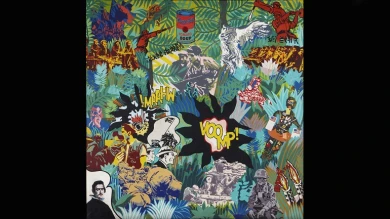
The international conference Cold Atlantic will examine the artistic, cultural and aesthetic exchanges produced between the USA, Europe, Africa and Latin America during the Cold War. The aim is to highlight the axes of alignment and artistic exchange between the geopolitically minor actors that were trapped inside the huge theatrical strategy from this period. The conference, which will be conducted through round-table discussions, lectures and dialogue, organised through an open international process, looks to recover relatively unstudied nodes of cultural influence and dissemination in its aim to decentralise the Paris-New York axis that still dominates and is ubiquitous in studies on the Cold War and its artistic incarnations, thus fostering discussion that grants a voice to the forms of cultural expression that materialised outside official power structures.
These dialogues and interactions will be analysed within a Cold War context, whilst also proceeding from the destabilisation of the status quo brought about by the Bandung Conference (1955) and the Hungarian Revolution (1956). Consequently, it underscores the forms of mediation, dissent and resistance that sought to offer alternative answers to the ideological and aesthetic split that defined the cultural and social climate after World War Two. The conference will call into question canonical narratives of artistic modernity by exploring transatlantic artistic networks, with a view to eliciting the plurality of the responses to the ideological positioning this war held on a cultural level. Therefore, from this perspective Cold Atlantic will chart a new cartography of artistic practices and institutional relations, both subjective and political.
The re-evaluation of crossroads and friction in artistic production, material culture and political resistance will help to reconsider different accounts of modern art’s struggle, displaying alternatives to the prevailing Western vision, whilst also calling attention to the links that would bring dissident responses to life in the geopolitical order of the Cold War, a key period in the configuration of today’s global world. Spain’s own “peripheral” position with regard to the UK, France and the United States opens up a space that fosters a reconsideration of the role of modern art, questioning accounts based on the concept of progress that have predominated the study of artistic modernity.
Scientific Committee
Paula Barreiro López, Fabiola Martínez Rodríguez, Chema González, Carlos Prieto del Campo, Olga Fernández López, Juan Albarrán, Julia Bailey, Andrea Giunta, Serge Guilbaut, Jonathan Harris and Jesús Carrillo
Within the framework of the research project
Decentralised Modernities: Art, Politics and Counterculture in the Transatlantic Axis during the Cold War (HAR2014-53834-P)
Associated activities
Predoctoral workshop at the University of Barcelona, 8 and 9 September 2016
Acknowledgements
Organised by
Museo Reina Sofía, Saint Louis University, Universidad de Barcelona and Universidad Autónoma de Madrid
In collaboration with
Organized by


Más actividades
Rethinking Guernica
Monday and Sunday - Check times
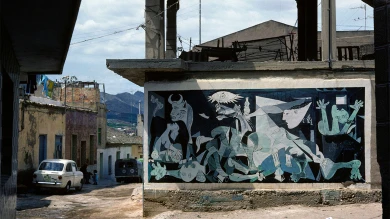
This guided tour activates the microsite Rethinking Guernica, a research project developed by the Museo Reina Sofía’s Collections Area, Conservation and Restoration Department and the Digital Projects Area of the Editorial Activities Department, assembling around 2,000 documents, interviews and counter-archives related to Pablo Picasso’s painting Guernica (1937).
The visit sets out an in-situ dialogue between the works hung around the painting and a selection of key documents, selected by the Museo’s Education Team and essential to gaining an idea of the picture’s historical background. Therefore, the tour looks to contribute to activating critical thought around this iconic and perpetually represented work and seeks to foster an approach which refreshes our gaze before the painting, thereby establishing a link with the present. Essentially revisiting to rethink Guernica.
Difficulty. Forms and Political Effects of Deviation in Writing and Contemporary Art
23 February – 14 December 2026 – Check programme
Difficulty. Forms and Political Effects of Deviation in Writing and Contemporary Art is a study group aligned towards thinking about how certain contemporary artistic and cultural practices resist the referentiality that dominates the logics of production and the consumption of present-day art. At the centre of this proposal are the concepts of difficulty and deviation, under which it brings together any procedure capable of preventing artistic forms from being absorbed by a meaning that appears previous to and independent from its expression. By ensuring the perceptibility of their languages, difficulty invites us to think of meaning as the effect of a signifying tension; that is, as a productive and creative activity which, from the materiality of art objects, frees aesthetic experience from the representational mandate and those who participate in it from the passiveness associated with tasks of mimesis and decoding.
The economy of the referential norm translates the social logic of capitalism, where insidious forms of capturing subjectivity and meaning operate. In the early 1980s, and adopting a Marxist framework, poet Ron Silliman highlighted how this logic entailed separating language from any mark, gesture, script, form or syntax that might link it to the conditions of its production, rendering it fetichised (as if without a subject) and alienating its users in a use for which they are not responsible. This double dispossession encodes the political strategy of referential objectivity: with no subject and no trace of its own consistency, language is merely an object, that reality in which it disappears.
The political uses of referentiality, more sophisticated today than ever before, sustain the neoliberal-extractivist phase of capitalism that crosses through present-day societies politically, economically and aesthetically. Against them, fugitive artistic practices emerge which, drawing from Black and Queer studies and other subaltern critical positions, reject the objective limits of what exists, invent forms to name what lies outside what has already been named, and return to subjects the capacity to participate in processes of emission and interpretation.
Read from the standpoint of artistic work, the objective capture of referentiality may be called transparency. Viewed from a social contract that reproduces inequality in fixed identity positions, transparent in this objectivity are, precisely, the discourses that maintain the status quo of domination. Opposite the inferno of these discourses, this group aims to collectively explore, through deviant or fugitive works, the paradise of language that Monique Wittig encountered in the estranged practices of literature. For the political potency of difficulty — that is, its contribution to the utopia of a free language among equals — depends on making visible, first, its own deviations; from there, the norm that those deviations transgress; and finally, the narrowness of a norm which in no way exhausts the possibilities ofsaying, signifying, referring and producing a world.
From this denouncement of referential alienation, fetishisation and capture, Difficulty. Forms and Political Effects of Deviation in Writing and Contemporary Art turns its attention to the strategies of resistance deployed by contemporary artists and poets. Its interest is directed towards proposals as evidently difficult or evasive as those of Gertrude Stein, Lyn Hejinian, Theresa Hak Kyung Cha, Kameelah Janan Rasheed, Kathy Acker, María Salgado and Ricardo Carreira, and as seemingly simple as those of Fernanda Laguna, Felix Gonzalez Torres and Cecilia Vicuña, among other examples that can be added according to the desires and dynamics of the group.
The ten study group sessions, held between February and December, combine theoretical seminars, work with artworks from the Museo Reina Sofía’s Collections and exhibitions, reading workshops and public programs. All these formats serve as spaces of encounter to think commonly about certain problems of poetics — that is, certain political questions — of contemporary writing and art.
Difficulty. Forms and Political Effects of Deviation in Writing and Contemporary Art inaugurates the research line Goodbye, Representation, through which the Museo Reina Sofía’s Studies Directorship seeks to explore the emergence of contemporary artistic and cultural practices which move away from representation as a dominant aesthetic-political strategy and redirect their attention toward artistic languages that question the tendency to point, name and fix, advocating instead for fugitive aesthetics. Over its three-year duration, this research line materializes in study groups, seminars, screenings and other forms of public programming.

CLINIC 2628. A Community of Writing and Research in the Arts
February – October 2026
Clinic 2628 is a project which supports and brings together writings which stem from the intention to offer a space and sustainable time for research work in art and culture. Framed within an academic context which is increasingly less receptive to the forms in which thinking happens and is expressed, the aim is to rescue the academic from its neoliberal trappings and thus recover the alliance between precision and intuition, work and desire. A further goal is to return writing to a commons which makes this possible through the monitoring of processes and the collectivisation of ideas, stances, references and strategies.
The endeavour, rooted in a collaboration between the Museo Reina Sofía’s Studies Directorship and the Artea research group, via the i+D Experimenta project, is shaped by three annual editions conceived as spaces of experimentation, discussion and a demonstration of writings critical of what is put forward by today’s academia.
What forces, forms and processes are at play when writing about art and aesthetics? In academia, in museums and in other cultural institutions, the practice of writing is traversed by productivist logics which jeopardise rhythms of research and experimentation. The imposition of both scientism inherent in the structure of “the paper” and the quantifying of results which demand a criterion of quality and visibility sterilise and smoothen, from the outset, the coarseness that is particular to writing understood from the concrete part of language: phonic, graphic, syntactic and grammatical resistance connecting the language user to the community the language unites and activates. They also sterilise the roughness enmeshed in the same desire to write, the intuitive, clear and confusing pathways that once again connect the writer to those reading and writing, participating in a common good that is at once discovered and produced.
The progressive commercialisation of knowledge propelled by cognitive capitalism moves further away from the research and production of knowledge in artworks and artistic languages and practices. The work of curators and archive, criticism, performances and essays formerly saw a horizon of formal and emotional possibilities, of imagination that was much broader when not developed in circumstances of competition, indexing and impact. Today, would it be possible to regain, critically not nostalgically, these ways; namely, recovering by forms, and by written forms, the proximity between art thinking and its objects? How to write in another way, to another rhythm, with no more demands than those with which an artwork moves towards different ways of seeing, reading and being in the world?

Aesthetics of Peace and Desertion Tactics
8 October 2025 – 24 June 2026
The study group Aesthetics of Peace and Tactics of Desertion: Prefiguring New Pacifisms and Forms of Transitional Justice proposes a rethinking—through both a theoretical-critical and historical-artistic lens—of the intricate network of concepts and practices operating under the notion of pacifism. A term not without contestation and critical tension, pacifism gathers under its name a multiplicity of practices—from anti-militarism and anti-war movements to non-violence activism—while simultaneously opening urgent debates around violence, justice, reparation, and desertion. Here, pacifism is not conceived as a moral doctrine, but as an active form of ethical and political resistance capable of generating aesthetic languages and new positions of social imagination.
Through collective study, the group seeks to update critical debates surrounding the use of violence and non-violence, as well as to explore the conflict of their representation at the core of visual cultures. In a present marked by rearmament, war, genocide, and the collapse of the social contract, this group aims to equip itself with tools to, on one hand, map genealogies and aesthetics of peace—within and beyond the Spanish context—and, on the other, analyze strategies of pacification that have served to neutralize the critical power of peace struggles. Transitional and anti-punitive justice proposals will also be addressed, alongside their intersections with artistic, visual, and cinematic practices. This includes examining historical examples of tribunals and paralegal activisms initiated by artists, and projects where gestures, imaginaries, and vocabularies tied to justice, reparation, memory, and mourning are developed.
It is also crucial to note that the study programme is grounded in ongoing reflection around tactics and concepts drawn, among others, from contemporary and radical Black thought—such as flight, exodus, abolitionism, desertion, and refusal. In other words, strategies and ideas that articulate ways of withdrawing from the mandates of institutions or violent paradigms that must be abandoned or dismantled. From feminist, internationalist, and decolonial perspectives, these concepts have nourished cultural coalitions and positions whose recovery today is urgent in order to prefigure a new pacifism: generative, transformative, and radical.
Aesthetics of Peace and Tactics of Desertion, developed and led by the Museo Reina Sofía’s Studies Management, unfolds through biweekly sessions from October to June. These sessions alternate between theoretical discussions, screenings, work with artworks and archival materials from the Museo’s Collection, reading workshops, and public sessions. The group is structured around sustained methodologies of study, close reading, and collective discussion of thinkers such as Judith Butler, Elsa Dorlin, Juan Albarrán, Rita Segato, Sven Lütticken, Ruth Wilson Gilmore, and Franco “Bifo” Berardi; historical episodes such as the anti-nuclear and anti-arms race movement in Spain; and the work of artists and activists including Rojava Film Commune, Manuel Correa and the Oficina de Investigación Documental (Office for Documentary Investigation), and Jonas Staal, among other initial cases that will expand as the group progresses.
equipoMotor
Jueves alternos, 23 de octubre, 2025 - 11 de junio, 2026 - 17:30 h
El programa equipoMotor regresa en su edición 25-26 con un aire espectral y mutante para lanzar la pregunta: ¿y si el Museo fuera «un poco más Frankenstein»? Inspirándose en dicho monstruo y en todas aquellas criaturas que desafían la norma desde los márgenes, el proyecto de mediación cultural Galaxxia diseña y acompaña una edición incisiva, intergeneracional y descentralizadora, donde saberes invisibilizados, cuerpos raros y deseos molestos se entrelazan para generar nuevas formas de imaginación crítica y radical. En los sótanos y corredores del Museo —un particular laboratorio— las dudas no se esconden: son materia prima.
Así, para este curso el equipoMotor convoca a personas de todas las edades que hayan participado en ediciones anteriores de los distintos equipos del Área de Educación a recorrer el Museo como quien manipula un cuerpo abierto: descoyuntando algunas de sus categorías teóricas y artísticas —la necropolítica, lo crip-cuir, la lucha de clases, las políticas del malestar, la decolonialidad, la temporalidad cuir, la descentralización institucional o el feísmo— para articular un relato díscolo, remendado y palpitante.
El programa se estructura en bloques temáticos sobre lo freak como metodología, el trabajo cultural, la intergeneracionalidad y la diversidad territorial. Cada bloque a su vez se despliega en sesiones que combinan disparadores teóricos y estéticos, visitas a exposiciones y espacios liminales del Museo, talleres artísticos con artistas, ejercicios de curaduría audiovisual colectiva y de relatoría radiofónica, así como instancias de activación pública, mediante proyecciones de cine experimental y coloquios compartidos con el público, en complicidad con el archivo Hamaca y el Área de Cine y Nuevos Medios del Museo.
De este modo, la presente edición incorpora una particularidad: el grupo de participantes irá transformándose en un «colectivo curatorial audiovisual temporalmente autónomo», con capacidad de incidir en la programación del Museo y de abrir la conversación de equipoMotor al público general, cuestionando y expandiendo así los límites entre las cabezas que deciden, las manos que producen y los cuerpos y presencias que habitan la institución. Las personas seleccionadas en la modalidad oyente serán invitadas a las proyecciones públicas, así como a otras activaciones y momentos de apertura del equipoMotor.
Frente al relato de un museo homogéneo, pulcro y lineal, apostamos por un Museo disidente, contradictorio y lleno de vida residual. Un Museo que no tema hacerse preguntas incómodas ni mostrar sus cicatrices. equipoMotor. Un poco más Frankenstein no busca repensar el cuerpo de la institución, sino habitarlo en sus desgarros, tal como es: híbrido, inacabado, infecto, fantasmagórico… y cargado de esporas y chispas por venir.